
By Vervida Home · Reviewed July 22, 2026
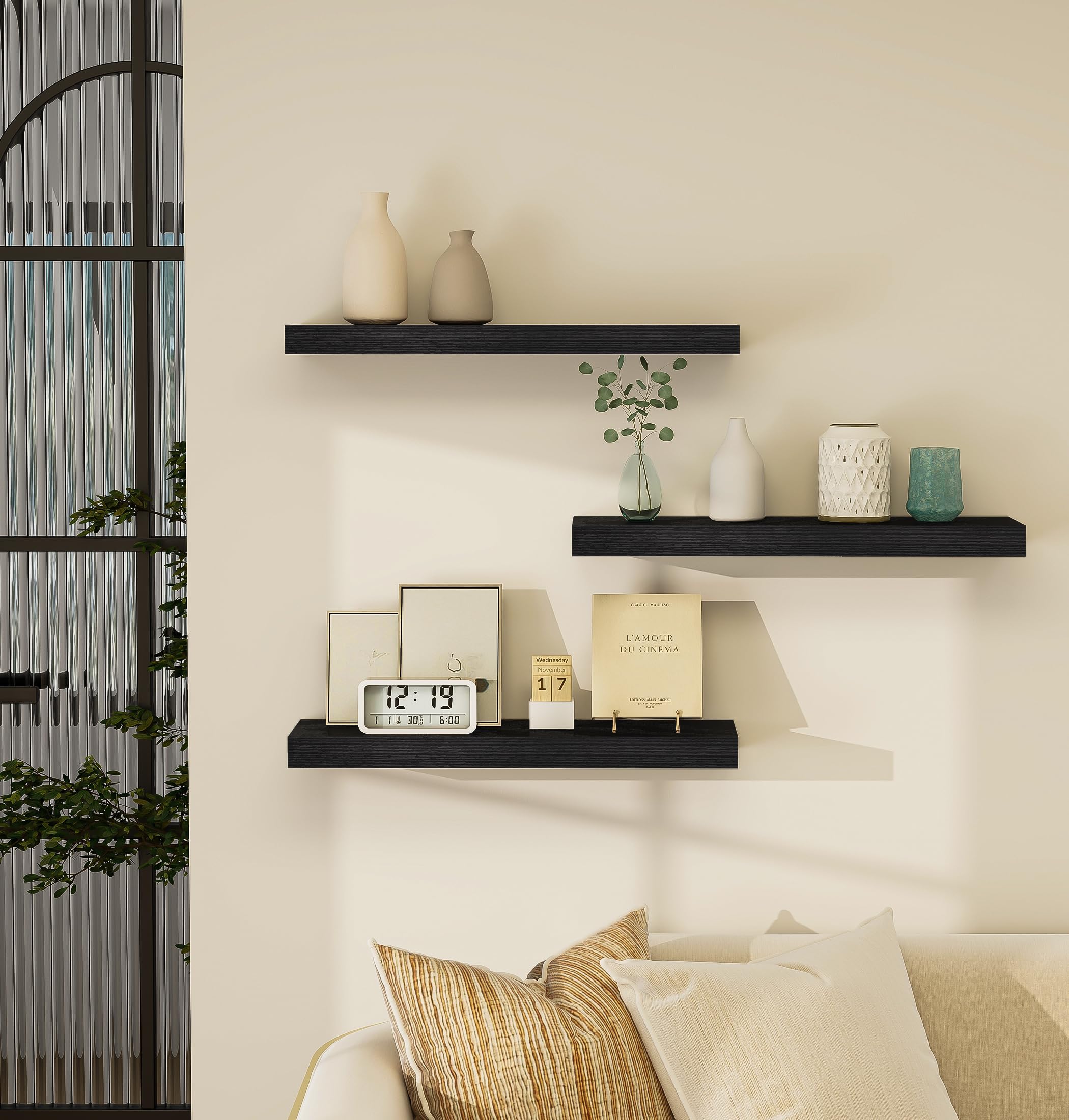
A calmer floating-shelf display usually starts with one focal idea, a small number of supporting object groups, and visible breathing room. Rather than trying to fill every open inch, arrange related objects together, vary their scale deliberately, then remove what does not help the composition.
How we made this guide
This guide adapts museum and visual-communication display principles to home shelf styling. It is not experimental research on floating shelves in homes and does not make mounting or load-distribution claims.
Choose one focal idea
Give each shelf arrangement a clear purpose: perhaps a small reading corner, a green accent, or a frame-and-ceramic grouping. Once the focal idea is clear, every supporting object should reinforce it. If an object has no role in the visual story or the room’s daily use, leave it out.
Group related objects
Place objects that belong together close enough to read as one group. Separate unrelated groups so the eye can understand each arrangement without scanning a continuous row of unrelated items. This approach makes a shelf feel intentional even when it holds practical items.
Leave breathing room
Visible space around and between groups helps the display remain legible. Empty space is not unfinished space; it gives the focal object and supporting pieces room to register. Edit down before adding more accessories.
Use scale and contrast with purpose
Vary height, shape, or texture so the arrangement is not flat, but keep the variation connected to the focal idea. A taller plant, a lower stack of books, and a small frame can create a readable rhythm without requiring a fixed object count, an odd-number rule, or perfect symmetry.
Style after the practical plan is settled
Decor does not change the need to confirm wall construction, mounting instructions, and suitable use. Keep fragile or heavy objects consistent with the installation plan, and reconsider the layout if the intended objects no longer fit the available surface or room clearance.
Browse options
Check current Vervida shelf details
Suitable and unsuitable scope
Suitable: Arranging books, plants, frames, and small objects into a clearer and calmer shelf display.
Not suitable: Deciding mounting, capacity, moisture resistance, child safety, pet safety, or accident-prevention requirements.
Source and limits
Sources reviewed: the Smithsonian’s Guide to Exhibit Development for focal ideas, the National Museum of American History’s design-team notes for visible space, and Frontiers research on relational learning for visual grouping. These sources inform a home-styling framework, not shelf-safety testing.
The source material supports focal points, visible space, grouping, simplification, and deliberate scale variation. It does not establish a mandatory number of objects, a symmetry rule, or a universal styling formula.